
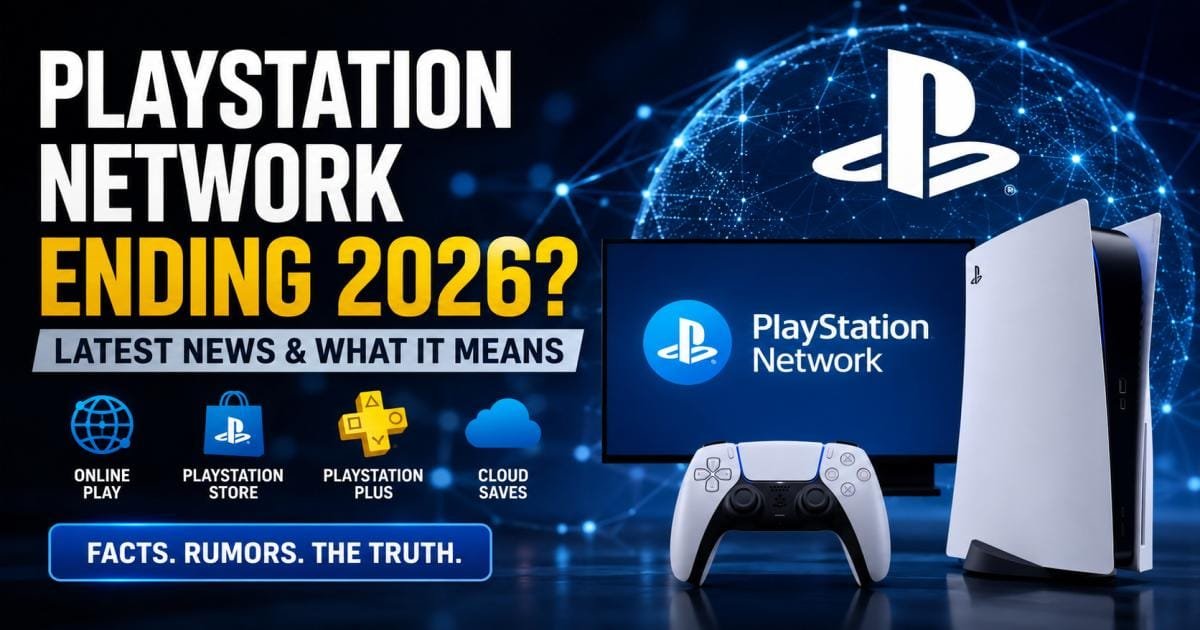

If you follow gaming news, you have likely seen the panic online: headlines claiming Sony is pulling the plug on its online services. The rumors about the PlayStation Network ending in 2026 have created widespread concern over potential loss of digital games, inactive multiplayer servers, and malfunctioning consoles.
Fortunately, the panic is based on a misunderstanding. Sony is undergoing a corporate visual rebranding, retiring the specific “PSN” abbreviation and “PlayStation Network” name in favor of simply calling the entire ecosystem “PlayStation.”
This guide details Sony’s announcements, clarifies internet misconceptions, and explains how these changes affect your console, account, and digital library.
Is PlayStation Network Ending in 2026?
No, the PlayStation Network is not shutting down in 2026. Sony is strictly implementing a visual rebranding effort. By September 2026, the company will phase out the terms “PlayStation Network” and “PSN” from menus, marketing, and developer guidelines. The servers, multiplayer matchmaking, and your digital purchases remain fully active.
Where Did the PlayStation Network Ending 2026 Rumor Come From?
How did a routine corporate update cause an internet-wide panic? The rumor spread through a combination of social media algorithms, misinterpreted corporate language, and real-world concerns about digital ownership.
Social media and YouTube speculation
As soon as gaming news outlets reported on Sony’s internal naming update, content creators jumped on the news. To maximize views, many designed sensationalized thumbnails featuring broken consoles and red text screaming “PSN ENDS IN 2026.” Casual users scrolling their feeds saw these headlines without reading the facts, triggering immediate alarm.
Misinterpreted headlines
Several gaming blogs chased web traffic by publishing misleading headlines like “Sony Phasing Out PlayStation Network By 2026.” While the actual articles usually clarified that the change was purely cosmetic, readers who only scanned the titles assumed the online servers were being permanently disabled.
Confusion between PSN and PlayStation branding
For nearly 20 years, players have treated “PlayStation” (the physical box) and “PSN” (the online service) as two distinct entities. When news broke that Sony was dropping the “PSN” label, people assumed the online portion was being deleted entirely, rather than absorbed into the main brand.
Why did misinformation spread so quickly?
The gaming community is highly sensitive to digital preservation. Players recently watched Nintendo close the 3DS and Wii U eShops entirely in early 2023. Because gamers are naturally anxious about losing access to older digital content, a rumor about a massive network shutdown caught fire instantly.
What Sony Actually Announced
To understand the reality of the situation, look directly at the documentation Sony sent to game studios. The company is adjusting its backend guidelines to match its modern business model, a shift focused entirely on visual rebranding and dropping the old acronym.
The reported PlayStation Network branding transition
According to leaked details from Sony’s Technical Requirements Checklist (TRC), the company wants to eliminate brand clutter. Instead of asking users to sign up for a “PlayStation Network Account” to play a game on a “PlayStation 5” console, the system will just ask for a “PlayStation Account.”
What changes in 2026
The modifications coming over the next few months are entirely text-based.
- Developer Guidelines: Game creators must remove the acronym “PSN” and the phrase “PlayStation Network” from game menus, boot-up screens, and user agreements.
- Console UI: Your PS5 and PS4 dashboards will gradually replace text mentioning “PSN Sign-In” with “PlayStation Sign-In”.
- Marketing: Digital advertisements and box art will no longer feature the classic PSN logo.
What stays the same
From a functional standpoint, nothing changes for you. Your current username, friends list, digital game library, DLCs, and virtual currencies remain exactly where they are. Active multiplayer servers will continue hosting online play just as they do today.
Sony’s official messaging and available evidence
The leaked excerpt from Sony’s developer communication lays out the strategy clearly: the company decided to phase out the older terms to capture its evolving digital services under one name. The document explicitly noted the changes are visual and introduce no technical alterations.
Will PlayStation Network Shut Down in 2026?
Let’s address the most common, specific anxieties point-by-point so you know exactly how your console will operate after the late-2026 deadline.
Can you still play online?
Yes. Online multiplayer matchmaking for games like Call of Duty, Helldivers 2, and Apex Legends will experience no downtime. The network servers keep running normally.
Will your PlayStation account continue to work?
Yes. Your account login credentials (email and password) remain identical. You do not need to sign up for a new profile or change your existing account settings.
What happens to digital purchases?
Every game, expansion pack, and theme you have purchased digitally remains yours to download and play. The digital storefront is simply dropping the “Network” name to become the standardized PlayStation Store.
Will cloud saves remain available?
Yes. Cloud storage for saved game data will continue functioning. Your save files will upload automatically in the background, keeping your progress safe.
What about PlayStation Plus?
PlayStation Plus continues running as Sony’s premier subscription model. The service keeps providing monthly games, online multiplayer access, and the game catalog for Extra and Premium members.
What the Changes Mean for PlayStation Players
While the technical framework remains steady, different groups within the gaming community will see slight shifts in how they interact with Sony’s ecosystem.
| Player Base | Primary Impact | What to Expect |
| PS4 Users | UI text changes & legacy service wind-down | Menus will drop “PSN” text. Sony continues to slowly reduce secondary PS4 web features. |
| PS5 Users | UI text changes | Gradual replacement of the term “PSN” with “PlayStation” across all system firmware. |
| PC Gamers | Standardized login requirements | Sony PC ports still require a unified “PlayStation Account” for multiplayer, but setup screens omit “PSN.” |
| Future Console Owners | Clean slate integration | The eventual PlayStation 6 ecosystem will launch entirely without old PSN terminology. |
PS4 users
For PlayStation 4 owners, this marks another step toward the console becoming a legacy system. The core online multiplayer framework remains active, but Sony has already begun scaling back secondary features, like older web filtering APIs.
PS5 users
PlayStation 5 players experience the most straightforward transition. As firmware updates roll out, text elements on the screen shift to the unified naming convention.
PC players using PlayStation accounts
Sony’s strategy of bringing live-service titles to PC via Steam requires players to link their profiles. You still need a “PlayStation Account” for cross-play access, making the onboarding process simpler without the older network branding attached.
Future PlayStation console owners
When the next generation of hardware arrives, the “PSN” brand will be entirely absent. Sony is setting up this new architecture so future hardware hooks directly into a singular platform identity.
What Will Not Change
Amidst the corporate adjustments, the baseline pillars of the platform remain locked in place.
- Trophy Lists: Every platinum, gold, silver, and bronze trophy you have unlocked since the PS3 era remains securely tied to your profile.
- Wallet Balance: Any funds currently sitting in your digital store wallet remain fully available to spend.
- Payment Methods: Your saved credit cards, PayPal details, and billing information transfer over naturally.
- Cross-Play Systems: Cross-platform matchmaking with PC, Xbox, and Nintendo Switch players continues working without interruption.
Why Sony May Be Moving Away from the PSN Brand
Phasing out a brand name as recognizable as the PlayStation Network might seem strange. Look closely at the modern landscape, however, and the move makes perfect business sense. This visual rebranding effort aligns with how players actually use the hardware today.
Evolution of the PlayStation ecosystem
When the PlayStation Network launched in 2006, online gaming was a secondary feature, a literal “network” bolted onto the console. Today, digital downloads, streaming, and remote play are the primary focus. The word “Network” feels outdated because the digital space is the platform itself.
Unified account strategy
Sony wants one universal account for all entertainment spaces. A single “PlayStation Account” lets a consumer log into their PS5, a mobile app, or a PC port. Getting rid of the console-specific “PSN” abbreviation makes the ecosystem sound far more inviting to non-console players.
Cross-platform gaming expansion
As Sony expands its presence on PC, keeping the “Network” moniker causes friction. PC players often find it odd to sign up for a console-branded “Network” to play a game natively on a computer. A clean “PlayStation Account” fixes this.
Modern branding considerations
Modern corporate branding heavily favors simplicity. Microsoft previously retired the “Xbox Live” name to roll its services under the main Xbox brand. Sony is following a similar philosophy by leaning entirely on its strongest asset: PlayStation.
Common Misconceptions About PlayStation Network Ending 2026
To combat the massive amount of fake news online, review the facts behind the top five myths running rampant through the community.
“PSN is shutting down forever”
False. The servers are not turning off. The infrastructure is simply getting a visual name change on your dashboard.
“All digital games will disappear”
False. Your digital collection is safe. You maintain full ownership rights to download, patch, and play every game sitting in your digital purchases tab.
“PlayStation Plus will end”
False. PlayStation Plus remains highly profitable for Sony. The service continues providing monthly games and multiplayer access.
“PS4 will stop working”
False. Your PS4 console still connects to the internet and plays multiplayer games.
“You must create a new account”
False. Your existing profile automatically transitions into the updated system layout. You do not need to alter your login credentials.
How This Could Affect Digital Game Ownership
The PlayStation Network ending 2026 rumor highlights a broader conversation regarding digital media preservation. While the modern ecosystem is safe, Sony is actively phasing out storefront support for older legacy platforms.
Purchased games
When you buy a digital game today, you purchase a license to download and play that software. Sony’s brand change does not alter or cancel any active licenses on PS4 or PS5.
Download history
Your entire transaction log and download history remain preserved. You access older titles via the exact same library tab on your console.
Licenses
Sony’s backend license verification servers continue running exactly as before. The digital handshake your console makes with the servers to verify you own a game remains intact.
Backward compatibility
Because the core network architecture is untouched, backward compatibility features are unharmed. Your PS5 still downloads and runs compatible PS4 titles flawlessly.
Consumer concerns (The Real Shutdown)
The only legitimate store closure happening involves antique platforms. The PlayStation Store for the PS3 and PS Vita is scheduled for a phased regional shutdown starting in August 2026, leading to a full global closure by July 2027. Once those store gates close, you cannot buy new digital games on those specific old systems. However, you can still redownload past purchases.
Timeline of the PlayStation Network Ending 2026 Story
To see how this narrative evolved from an internal corporate note to an internet rumor, follow the timeline of events. Notice how the visual rebranding directive was twisted into a shutdown warning.
- Late 2025: Sony quietly begins removing early references to “PSN” from backend service documents.
- March 2026: Gaming outlets leak an internal email from Sony to developers, detailing a mandatory transition away from the “PSN” acronym by autumn 2026.
- Mid-2026: Social media channels twist the developer email leak into viral panic videos claiming the “PlayStation Network is ending in 2026.”
- August 2026: The first regional waves of the legacy PS3 and PS Vita store closures begin rolling out.
- September 2026: The official target deadline for Sony’s Technical Requirements Checklist (TRC) goes into effect. Newly released titles must use “PlayStation” branding rather than “PSN”.
- July 2027: The global storefronts for the legacy PS3 and PS Vita officially close their doors permanently for new purchases.
What Gamers Should Do Right Now
Because this change is purely a visual shift in branding, you do not need to scramble to protect your profile. You can take a few basic steps to keep your account secure for the future.
Enable Two-Factor Authentication (2FA) through your account settings using an authenticator app. Double-check that the email address associated with your profile is accurate so you receive official transition notifications directly from Sony. Finally, if you still actively play on a PlayStation 3 or a PS Vita, buy any rare digital-only exclusives you want before those specific legacy stores close in 2027.
Final Verdict
The internet rumor mill excels at turning boring corporate admin notes into panic-inducing stories. The viral rumors surrounding the PlayStation Network ending 2026 scenario are entirely false.
Sony is simply refreshing its brand image. By tossing out a 20-year-old piece of jargon, the company keeps its messaging clean and unified under the legendary “PlayStation” name. Your trophies are secure, your digital purchases are protected, and your favorite online multiplayer servers will stay powered up. Turn on your console, log into your favorite game, and rest easy. The future of the platform is perfectly safe.
Frequently Asked Questions (FAQ)
Is PlayStation Network ending in 2026?
No. Sony is not shutting down its servers. The company is strictly retiring the name “PlayStation Network” and the abbreviation “PSN” in a visual branding update by September 2026.
Is Sony shutting down PSN?
No, the online servers are staying active. The service is undergoing a cosmetic rebrand to combine all digital offerings under the singular banner name: PlayStation.
Will I lose my digital games?
Absolutely not. Every single digital game, piece of downloadable content (DLC), and software license you bought remains completely safe and accessible in your game library.
Will PlayStation Plus still work?
Yes, PlayStation Plus continues working normally. Your subscription benefits, including online multiplayer access and monthly downloadable games, remain fully active.
Can I still play online after 2026?
Yes. Online multiplayer servers, voice chats, and friend connection systems carry on working seamlessly throughout 2026 and beyond.
Is the PlayStation Store closing?
The modern PlayStation Store on PS5, PS4, and PC browsers is not closing. However, the legacy storefronts for the much older PS3 and PS Vita consoles close down globally for new purchases in July 2027.
What exactly changes in 2026?
The only changes are visual text adjustments. You will stop seeing the words “PlayStation Network” or “PSN” on your console menus and loading screens. They will be replaced by the word “PlayStation.”


[…] Picking just 30 games requires strict testing. We evaluated these new PS5 releases in 2026 based on frame rate stability, loading times via the solid-state drive, and how well they use the DualSense controller’s adaptive triggers. The games below represent the absolute peak of current console gaming. […]