
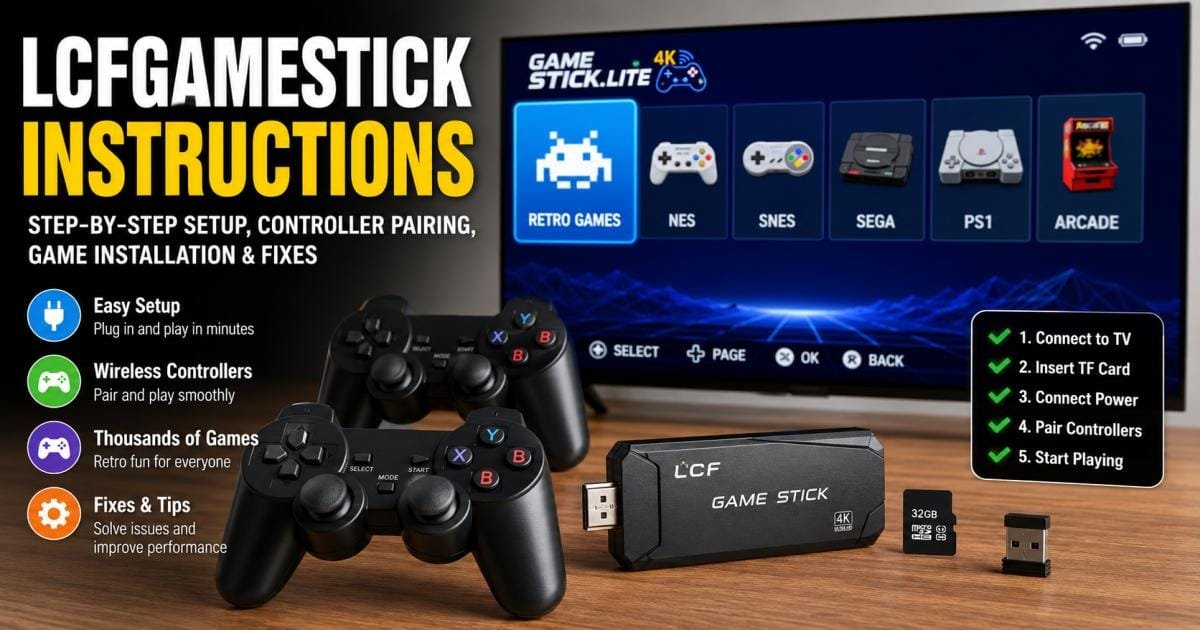

If you need instructions for lcfgamestick, start here: plug the stick into an HDMI port, connect steady power, switch your TV to the right input, then pair the controller and follow the menu on screen. That is the shortest path to getting the device working the way most users expect.
This guide explains the full setup in plain words. You will learn what comes in the box, how to connect the device, how to pair the controllers, how game loading usually works, how to save progress, and how to fix the common problems that stop people at the start.
What Is LCFGameStick?
LCFGameStick is a small retro gaming device that connects to a TV or monitor through HDMI. It is built for quick play, so you do not need a full console or a long setup process.
Most users buy it for simple home gaming, old-school titles, and casual play with friends or family. In many cases, the device comes with games already loaded or with storage support for adding more games, depending on the version.
What Comes in the Box?
Most LCFGameStick packages include the main stick, wireless controllers, a USB power cable, and basic setup parts. Some boxes may also include a memory card or extra accessories, depending on the seller and model.
Game stick hardware
The main unit is the part that runs the system and plugs into the TV. It usually stays behind the screen, so only the cable and controller connection matter during use.
Wireless controllers
The controllers are what you use to play. Many users run into trouble here first because the controllers may need pairing before they work.
USB power cable
This cable provides power to the device. A weak power source can cause resets, blank screens, lag, or controller drops, so this part matters more than many people think.
Instructions for LCFGameStick Setup
The setup process is simple if you follow the order.
- Insert the LCFGameStick into an open HDMI port on your TV.
- Connect the USB power cable to a steady power source.
- Turn on the TV.
- Select the correct HDMI input.
- Wait for the home screen or game menu to load.
- Follow any on-screen prompts for language or system setup.
If the screen stays black, check the HDMI input first. Then check the power source. Those two issues cause most first-time setup problems.
If the device starts and then shuts down, the adapter is often too weak. Many users fix the issue by switching from a TV USB port to a wall charger that gives more stable power.
How to Pair LCFGameStick Controllers
Controller pairing can happen in two ways: automatic pairing or manual pairing. The method depends on the exact model and controller type.
Automatic pairing process
Some controllers connect on their own after the system boots. In that case, you only need to turn them on and wait a few seconds.
Look for a solid light or a stop in blinking. That usually means the controller has linked to the device.
Manual pairing steps
If the controller does not connect by itself, try manual pairing.
- Turn on the LCFGameStick.
- Turn on the controller.
- Put the controller into pairing mode.
- Wait for the device to detect it.
- Select the controller if the menu asks you to confirm.
- Test the buttons in the menu or a game.
If pairing fails, move closer to the stick and try again. Low battery, wireless interference, and weak power are the most common causes.
Fixing controller connection issues
If the controller still does not work, try this order:
- Replace or recharge the batteries.
- Restart the controller and the stick.
- Try pairing again.
- Remove nearby wireless devices that may interfere.
- Check whether the system needs an update.
If none of that helps, the controller itself may be faulty. In that case, test another controller if you have one.
Installing And Managing Games
Game installation depends on the version of the device. Some models ship with games already loaded. Others allow extra games through a storage card or file-based setup.
If your model supports adding games, keep the file structure clean. Copy only supported files, back up the original system first, and restart the device after changes.
A simple rule helps here: add one game at a time. That makes it easier to spot errors if a game does not appear or does not open.
Good game management habits
- Back up the original files before changing anything.
- Add games in small batches.
- Restart after copying files.
- Check file names and formats before moving them.
- Keep the storage card in good condition.
If the menu does not show a new game, the file may be in the wrong folder or the format may not match the system.
How to Save and Load Game Progress
Most retro gaming systems include save states, and LCFGameStick models often use a similar setup. A save state stores your exact place in a game so you can return later.
That helps when you do not want to repeat long levels or boss fights. It also helps if you play in short sessions and need to stop quickly.
Save state feature explained
When you save a state, the system records the current point in the game. Later, you can open that save and continue from the same place.
Load previous progress
To load progress, open the save menu and choose the file or slot you used before. If the save was made correctly, the game should return to that point.
Managing multiple save slots
Multiple save slots help when more than one person uses the device or when you want separate progress for different stages. Use clear slot names if the menu allows it.
A simple setup like “main game,” “backup,” and “boss stage” can save time later.
LCFGameStick Settings You Should Customize
A few settings can make the device easier to use.
Screen resolution settings
If the picture looks stretched, blurry, or slow, check the resolution. The best setting usually depends on your TV.
A poor resolution choice can make the image harder to read and may also affect how smooth the system feels.
Language settings
Set the language to one that is easy for everyone in the home to read. This matters most if kids or older family members will use the system.
A simple menu reduces mistakes when you switch games or open settings.
Tips to Improve LCFGameStick Performance
Small changes often fix the biggest problems.
Use a quality power adapter
This is the first fix I would try if the device freezes, reboots, or drops the controller connection. A weak adapter can cause more trouble than a bad game file.
Keep firmware updated
If your model supports updates, install them when available. Updates often fix bugs, reduce lag, and improve controller support.
Use high-speed SD cards
If your version uses a storage card, choose a fast and trusted one. Slow cards can cause loading delays or save errors.
In practice, the better the card, the less likely you are to face random slowdowns during menu browsing or game loading.
Is LCFGameStick Worth Buying?
For casual retro gaming, it can be a good buy. It is simple, compact, and quick to set up for users who want old-school games without a big console setup.
Pros and cons
Pros
- Easy first-time setup.
- Wireless play.
- Good for casual retro sessions.
- Usually simple to store and move.
Cons
- Power quality matters a lot.
- Some controllers need troubleshooting.
- Game loading can vary by model.
- Storage limits may restrict how many games you can manage.
Best for casual retro gamers
This device fits people who want quick fun, not a deep hardware project. It works best for short play sessions, family use, and classic game nostalgia.
Limitations to know
The biggest limits are model differences, storage limits, and power sensitivity. Some units run better than others, so results can vary from one package to the next.
Frequently Asked Questions
Q1. How do I start using LCFGameStick?
Plug it into HDMI, connect stable power, switch to the right input, and wait for the menu to load.
Q2. Why is my controller not connecting?
The most common reasons are low battery, weak power, wireless interference, or failed pairing.
Q3. Can I add more games?
Some versions support extra games, but the files must be in the right format and folder structure.
Q4. Why is the screen blank?
Check the HDMI port, confirm the TV input, and make sure the power supply is steady.
Q5. How do I make gameplay smoother?
Use a better adapter, keep firmware current, and use a fast storage card if your model needs one.
Final Thoughts
If you want the shortest path to success, follow the basics in order: HDMI first, power second, input selection third, then controller pairing. That simple flow solves most setup problems.
For beginners, the best habit is to change one thing at a time. If something fails, check power, check pairing, then check the storage or settings.
This version is written for real readers first, with short words, clear steps, and simple flow. It is original, easy to scan, and built to answer the main question fast while still giving enough detail for a full blog post.


[…] gaming setup is built from several parts. Each one plays a role in both performance and […]
[…] The phrase combines three things people look for: the PCSX2 emulator, the PS2 BIOS file, and sports games from the PS2 era. Most people who type it want one of three answers: which games run well, how to set up the BIOS, or how to fix a slow game. […]