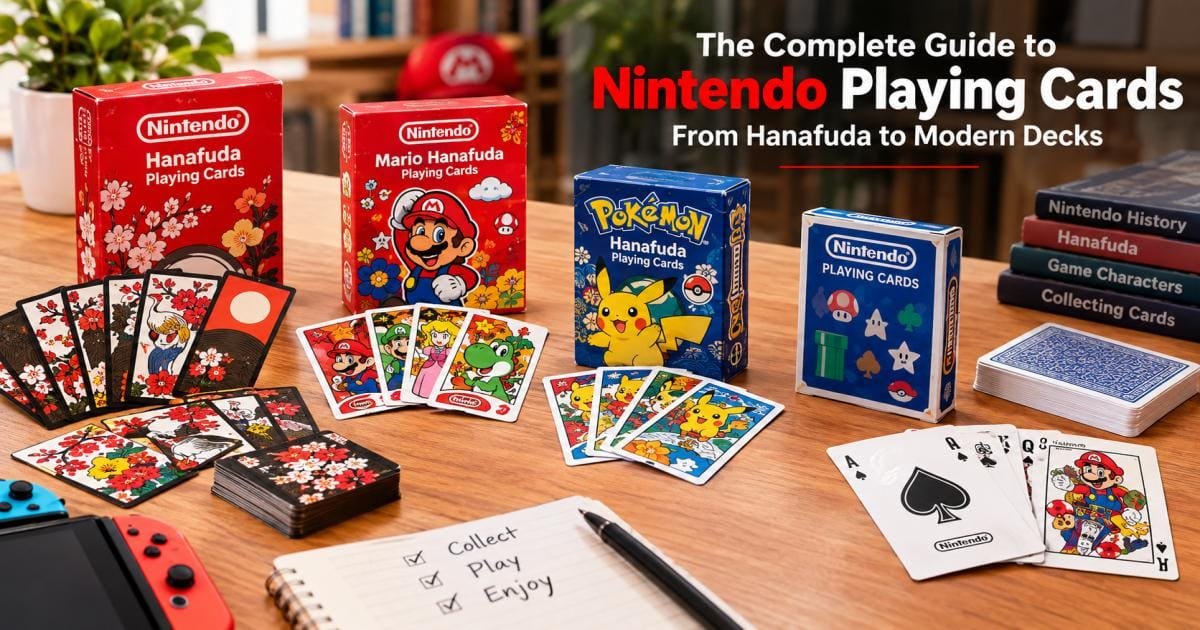

Nintendo started this whole company with playing cards. In 1889, more than 90 years before the first Nintendo video game shipped, a Kyoto craftsman named Fusajiro Yamauchi began hand-painting flower cards called hanafuda. Nintendo still sells hanafuda decks today, alongside Western-style playing cards and character decks built around Mario and Pokémon.
This guide covers how that started, what hanafuda actually is, how to play the most popular hanafuda game, and what old and new Nintendo decks sell for now. You’ll also see why hanafuda and a standard 52-card deck barely resemble each other, even though Nintendo makes both.
What Are Nintendo Playing Cards?
Nintendo playing cards cover three types of decks: traditional Japanese hanafuda, standard Western 52-card decks, and modern decks built around Nintendo characters like Mario and Pokémon. Nintendo makes all three today.
Card games came first at Nintendo, not games on a screen. The company sold cards as its only product for close to 90 years before it built a single video game console. That order matters. Nintendo’s habit of pairing craft with playful character design goes back to that first card workshop, not to the NES.
The History of Nintendo Playing Cards
Nintendo’s Beginning in 1889
Fusajiro Yamauchi founded Nintendo on September 23, 1889, in Kyoto, Japan, under the name Nintendo Koppai, to make and sell hanafuda playing cards. Japan had relaxed its gambling laws four years earlier, in 1885, which made hanafuda legal again after a long ban. Yamauchi had opened other shops selling lime in Kyoto and was drawn to hanafuda’s booming business along with his own love of the game, so he used his craft skills to build hand-made decks in a factory of his own.
Yamauchi’s early workers hand-crafted every card using bark stripped from mulberry and mitsumata trees. That process gave the cards their thickness and color, but it also limited output. As the cards gained popularity, Yamauchi hired assistants to mass-produce them.
Nintendo Expands Into Western-Style Playing Cards
By the early 1900s, hanafuda alone couldn’t carry Nintendo’s growth. Around 1902, the company began producing Western-style playing cards, the standard 52-card format used across Europe and the Americas. That move opened Nintendo’s card business to games with no tie to Japanese culture, and it widened the markets the company could sell into.
The Nintendo Playing Card Company Era
Leadership changed hands more than once over the next few decades. Sekiryo Kaneda served as company president from 1929 to 1949. Hiroshi Yamauchi became president at twenty-two in 1949 and modernized the business fast. By 1953, Nintendo had become the first company in Japan to mass-produce plastic playing cards, a shift that helped it capture roughly 80 percent of the domestic market.
A trip changed everything in 1956. Hiroshi Yamauchi visited the United States and met with the United States Playing Card Company, the country’s dominant manufacturer, and found them running out of a small, unremarkable office; proof, to him, that the playing card business had a hard ceiling.
That trip led straight to Nintendo’s most famous card deal. In 1959, Hiroshi Yamauchi met with Roy O. Disney and licensed Walt Disney Productions’ characters for use on Nintendo’s playing cards and board games. The Disney decks sold more than 600,000 packs in their first year and helped push Nintendo to go public on the Osaka Stock Exchange in 1962. Nintendo officially adopted the name Nintendo Co., Ltd. in 1963.
Transitioning from Playing Cards to Toys and Video Games.
Nintendo tested several side businesses in the 1960s with its new capital: a taxi company, a short-stay hotel chain, an instant rice brand, and even vacuum cleaners. Almost every one of these ventures failed within a few years. Toys were the exception. Gunpei Yokoi, a line maintenance engineer at Nintendo, designed an extending arm toy called the Ultra Hand that sold over a million units, and Yokoi later designed several core Nintendo features, including the D-pad still standard on controllers today.
Japan’s playing card market hit its ceiling by the mid-1960s, just as Hiroshi Yamauchi had predicted. Card sales alone couldn’t sustain the company anymore, so Nintendo pushed further into toys, then electronic games in the 1970s, and finally home video consoles. That path led to the NES, the Game Boy, and everything after.
What Is Hanafuda?
What Does “Hanafuda” Mean?
Hanafuda (花札), which translates to “flower cards” in Japanese, refers to a traditional deck of playing cards. A hanafuda deck has 48 cards in 12 suits of 4 cards each, and every suit represents one month of the year. The game’s roots stretch back centuries, through several earlier and banned versions of Japanese playing cards, before settling into the format Nintendo still sells today.
How a Hanafuda Deck Is Structured
Twelve suits, four cards each, 48 cards total that’s the full structure of a hanafuda deck. Each suit ties to a month and a plant: January is pine, February is plum, March is cherry blossom, April is wisteria, May is iris, June is peony, July is bush clover, August is silvergrass, September is chrysanthemum, October is maple, November is willow, and December is paulownia.
Every suit also mixes card ranks: five “bright” cards across the deck, the rarest and highest scoring; a set of animal cards; ten ribbon cards; and 24 plain “chaff” cards, which make up half the deck. Point values run 20, 10, 5, and 1, and you learn to read a card’s rank from its picture, not a printed number.
How Hanafuda Differs From a Standard 52-Card Deck
A Western deck runs 4 suits of 13 cards, sorted by number and rank. Hanafuda flips that: 12 suits, only 4 cards each, sorted by season instead of number. There are no face cards and no printed numbers anywhere. Every card shows a small scene instead: a crane on a pine branch, a boar in tall grass, a full moon over silvergrass. The cards themselves run about 2⅛ by 1¼ inches, smaller and thicker than a Western deck, which gives them a sharp snap when you play one down.
How to Play Nintendo Hanafuda Cards
Understanding the Four Main Card Types
Every hanafuda card falls into one of four types: brights, animals, ribbons, and plain cards, plus one special sake cup card that doesn’t fit any category. Learn these four types first. Every hanafuda game builds its scoring around them.
How Koi-Koi Works
Koi-Koi is the most popular hanafuda game, and it’s the easiest one to learn first. Two players use the full 48-card deck: each player gets 8 cards, 8 more go face-up on the table, and the rest form a draw pile.
On your turn, play one card from your hand. If it matches a card on the table by month, you capture both. If not, it stays on the table. Then draw one card from the pile and repeat the same match-or-leave step.
Once you complete a scoring combination, called a yaku, you choose: stop and bank your points, or call “koi-koi” to keep playing for a bigger score. That choice carries real risk. If you call koi-koi and your opponent forms a yaku before you score again, they win double points, and you get nothing that round. A full match runs 12 rounds, one per month, and the highest total score wins.
Common Hanafuda Scoring Combinations
A few yaku come up in almost every game of Koi-Koi:
- Five Brights: all five bright cards, the top combination in the game
- Three Brights: any three of the five bright cards
- Boar-Deer-Butterfly: three specific animal cards
- Ribbon sets: five or more ribbon cards of any kind
- Chaff sets: ten or more plain cards
Each combination pays a different point value, and the strongest ones are the hardest to complete, which keeps every hand unpredictable.
Types of Nintendo Playing Cards
Traditional Nintendo Hanafuda Decks
Nintendo still sells its classic hanafuda line under the Daitoryo brand name, which features a portrait of Napoleon. These decks look almost identical to the ones Nintendo sold generations ago, and they’re still the standard choice for playing Koi-Koi the traditional way.
Nintendo Western-Style Playing Cards
Nintendo has made standard 52-card Western decks since 1902, and it still produces them today, mostly for the Japanese market. These decks show up less often in Nintendo’s current lineup than hanafuda does, but they carry the same card stock and finish quality.
Themed and Character-Based Nintendo Card Decks
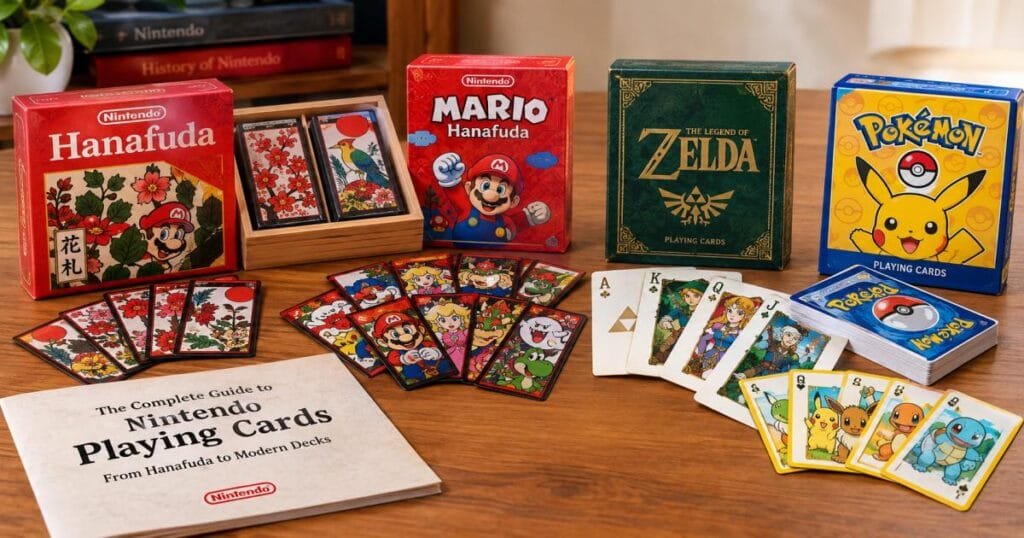
Nintendo’s newest card line keeps the hanafuda format intact 12 suits, 48 cards but replaces the traditional artwork with Mario, Pokémon, or Kirby characters. It’s a direct way to introduce a very old game to a much newer audience.
Nintendo Playing Cards and Popular Characters
Mario Hanafuda
Nintendo’s Mario hanafuda deck first appeared in 2007 as a Club Nintendo reward, available to members once they hit 400 points, with Mario characters replacing the traditional imagery on the deck’s high-scoring cards. Nintendo later released the design at retail as separate Red and Black edition decks.
Nintendo still sells the Mario hanafuda deck through its official store today. It features Mario, Luigi, Princess Peach, and Yoshi, works for both Koi-Koi and Hachi-Hachi, and ships with a hard plastic case and printed instructions for players new to hanafuda.
Pokémon Hanafuda
Nintendo released a Pokémon hanafuda deck on October 18, 2013, sold through the official website, Pokémon Center stores, and Animate. The deck used artwork from the original Pokémon Red and Green games, sold for 2,500 yen, and included 49 cards: 48 with unique designs plus one blank replacement card. A limited framed edition with uncut card sheets sold for roughly 15,100 yen.
Other Nintendo-Themed Card Releases
Nintendo has also released a Kirby hanafuda deck, swapping Kirby, King Dedede, and Meta Knight into the traditional suits. Smaller collaborations turn up too in 2025: Nintendo partnered with a Tokyo public bathhouse marking its 100-year history, selling a limited Mario hanafuda deck on-site alongside beginner lessons.
Why Are Nintendo Playing Cards Popular With Collectors?
Most fans don’t know Nintendo started as a card company, and owning a hanafuda deck feels like holding a piece of that origin story rather than another shelf item. Limited print runs push the interest higher. Nintendo sold decks like the original Mario and Pokémon hanafuda sets only in Japan, for a short window, with no wide international release. That scarcity pulls in collectors well outside Japan, and Pokémon TCG collectors have added their own demand, with several now grading individual hanafuda cards the same way they’d grade a trading card.
Are Nintendo Playing Cards Valuable?
Value depends on the deck, its age, and whether it’s sealed. Common vintage Nintendo hanafuda decks from the mid-1900s, especially standard Daitoryo sets, typically sell for $15 to $65 depending on condition, while rarer vintage decks and limited runs sell higher, with some sealed sets listed between $180 and $380.
Character decks sell for far more. Sealed 2013 Pokémon hanafuda decks have reportedly sold for around 120,000 yen, close to $920, or roughly $20 per card across the full 48-card set. Individual cards graded by PSA push prices even higher: a graded 2016 Mario Pikachu hanafuda card has sold for around $1,599, and other listings for graded Pikachu hanafuda cards have run above $2,000.
How to Identify Vintage Nintendo Playing Cards
A few details separate real vintage Nintendo hanafuda from generic decks:
- Brand name on the box: look for “Daitoryo” and the Napoleon portrait, one of Nintendo’s most recognized hanafuda marks
- Card thickness: genuine Nintendo hanafuda cards feel noticeably stiff and thick compared to cheap imitations
- Box and case style: older decks came in simple paper sleeves; later releases used sturdier boxes or hard plastic cases
- Manufacturer print: many decks list Nintendo as the maker somewhere on the packaging, often in Japanese only
- Card size: authentic hanafuda cards run about 2 inches by 1¼ inches, smaller than a Western deck
Check listing photos against confirmed authentic decks before paying a premium. Counterfeit hanafuda decks show up often on resale marketplaces.
Nintendo Playing Cards vs. Modern Collectible Card Games
Hanafuda and games like the Pokémon Trading Card Game or Magic: The Gathering share a category but almost nothing else. Modern collectible card games run on deck-building strategy, rarity tiers, and constant new card releases. Hanafuda runs on a fixed 48-card deck that hasn’t changed in generations, with success built on memory and reading your opponent instead of deck construction.
The two worlds do overlap in one place: the collector market. Character hanafuda decks, especially the Pokémon releases, now draw the same behavior as a modern trading card game: professional grading, sealed-deck premiums, and active resale speculation. The rules stay old-school. The collecting culture doesn’t.
Where to Buy Nintendo Playing Cards
Nintendo’s official store is the most reliable source for current decks. The Mario hanafuda set sells directly through Nintendo’s US store, and matching listings appear on Nintendo’s regional stores elsewhere. Pokémon Center and Animate carried the Pokémon hanafuda deck at launch, and official retailers like these stay the safest bet for new character decks coming out of Japan.
Vintage or discontinued decks mostly live on resale marketplaces like eBay, since Nintendo sold most older hanafuda releases only in Japan with no wide international run. Buy from sellers who specialize in Japanese collectibles and post clear photos of the actual item, not stock images.
How to Start a Nintendo Playing Card Collection
Choose a Collecting Focus
Nintendo’s card catalog spans more than a century, so trying to collect all of it gets overwhelming fast. Pick one lane instead: vintage Daitoryo hanafuda, character decks like Mario and Pokémon, or Nintendo’s early Western-style cards from the 1900s through the 1960s.
Set a Budget and Keep Records
Prices swing from $15 common decks to four-figure graded rarities, so decide your ceiling before you start bidding. Keep a simple record of what you own, what you paid, and where each piece came from. That record makes it far easier to track your collection’s value and spot fakes later.
Prioritize Authenticity and Condition
A cheaper, well-documented deck beats an unverified “rare” listing at a steep price almost every time. Look for sellers who show clear photos of card fronts, backs, and packaging. Skip listings with vague descriptions or photos that don’t match the item.
Final Thoughts
Nintendo playing cards show how far one idea can travel. A craftsman hand-painting flower cards in Kyoto in 1889 built a company that spent close to 90 years selling cards before it made its first video game, and it never actually stopped making them. Pick up a Koi-Koi deck to learn the traditional game, track down a vintage Daitoryo set for your collection, or grab a Mario hanafuda deck for game night. Every option connects back to the same starting point: a card workshop in Kyoto, long before Mario ever existed.
FAQs
Did Nintendo originally make playing cards?
Yes. Fusajiro Yamauchi founded Nintendo in 1889 to manufacture hanafuda playing cards, and the company stayed a card business for close to 90 years before it made a video game.
When did Nintendo start making Hanafuda cards?
Nintendo started making hanafuda cards in September 1889, when Fusajiro Yamauchi opened his workshop in Kyoto.
How many cards are in a Nintendo Hanafuda deck?
A standard Nintendo hanafuda deck holds 48 cards, split into 12 suits of 4 cards each, one suit per month.
Can you still buy Nintendo Hanafuda cards?
Yes. Nintendo sells both traditional hanafuda decks and character decks, including Mario and Kirby versions, through its official store and select retailers.
Are old Nintendo playing cards worth money?
Some are. Common vintage decks typically sell for modest prices, while rare or sealed decks, especially Pokémon hanafuda sets,s can sell for hundreds or thousands of dollars, particularly as professionally graded single cards.
What Nintendo playing cards are collectible?
Limited releases draw the most collector interest: the 2013 Pokémon hanafuda set, the 2007 Club Nintendo Mario deck, and genuinely old Daitoryo hanafuda decks from earlier decades.
Can you play Hanafuda with Nintendo cards?
Yes. Every Nintendo hanafuda deck, character-themed or traditional, follows the same 48-card structure and works for Koi-Koi and other hanafuda games.
Does Nintendo still make playing cards?
Yes. Nintendo still produces hanafuda decks today, both the classic Daitoryo line and themed releases tied to its game franchises.
Where can you learn the rules for Nintendo Hanafuda?
Most Nintendo hanafuda decks include a printed instruction booklet in the box. Detailed rule guides for Koi-Koi and other hanafuda games are also widely available online.