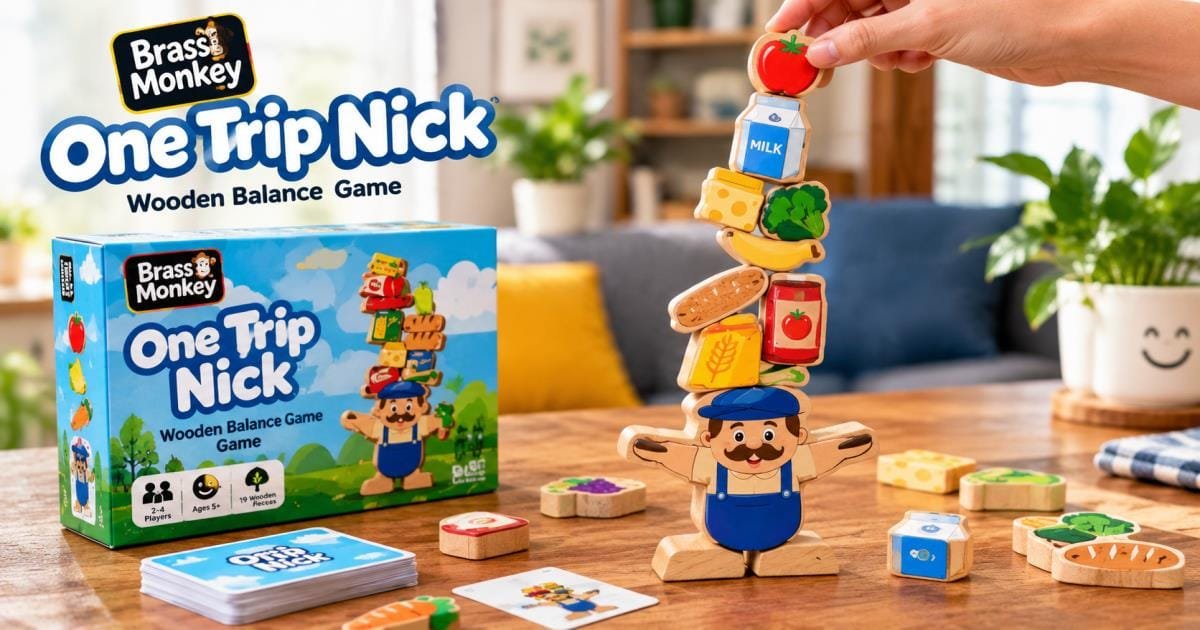

The Brass Monkey One Trip Nick wooden balance game turns a familiar frustration into table fun. Most people know the stubborn urge to carry every grocery bag, jug, and awkward package from the car in a single load. This game puts that stubbornness on the table. Players take turns stacking silly wooden grocery pieces onto a rocking man-shaped figure named Nick. The goal stays clear: keep the pile upright. The person who topples it is out. The last player left standing wins.
What sets this wooden balance game apart is the combination of a rocking base, irregularly shaped pieces, and a theme that almost everyone recognizes. It is not a pure abstract stacker. The pieces look like shopping bags, crates, a hockey stick, a baby, a cactus, and other everyday items that somehow end up in the same load. The humor lands every time the structure sways. Families, casual groups, and party hosts find it easy to teach and quick to play. Kids from about age five can join with a little guidance, while adults enjoy the physical challenge and the shared laughs when everything crashes.
What Is the Brass Monkey One Trip Nick Wooden Balance Game?
One Trip Nick is a stacking and balancing game built around a simple idea. Players add grocery-themed wooden items onto Nick, a man-shaped piece that stands on a curved rocker. Each successful placement grows the pile. Any fall on your turn removes you from the round. The last player who has not caused a collapse wins.
The “one trip” theme drives the whole experience. Nick refuses to make a second trip. Players help him by loading more and more items until the physics give out. The game type is pure dexterity: stacking, balancing, and careful hand control. There are no complex strategy tracks, resource cards, or hidden goals. Rounds move fast and the feedback is immediate.
Brass Monkey released the game in 2025. The brand sits under Galison and focuses on products that mix clean design with dry humor. Co-creators Mike Sayre and Melanie Bridges built Brass Monkey to sit somewhere between roadside souvenirs and fine china. One Trip Nick fits that voice. The pieces feel solid, the artwork has a vintage look, and the theme pokes fun at a common habit without needing explanation.
What Comes in the One Trip Nick Game?
The box holds 19 wooden pieces and a short instruction sheet. One piece is Nick himself—the man-shaped figure with the rocker base. The other 18 are grocery-themed items printed on both sides. You will find shopping bags, crates, a hockey stick, a baby, a potted cactus, and other odd shapes that create different balance challenges.
The wood is thick. Pieces survive repeated falls without easy chipping. The double-sided printing means the stack looks interesting from every angle. The box measures roughly 4 by 6.5 to 7 by 1.85 inches, so it stores easily and travels well. Overall presentation stays clean and playful. No plastic parts, no batteries, no tiny pieces that disappear under furniture.
How to Play One Trip Nick
Setup takes less than a minute. Empty all 19 pieces onto the table with the printed sides facing up. Stand Nick upright in the middle so every player can reach him.
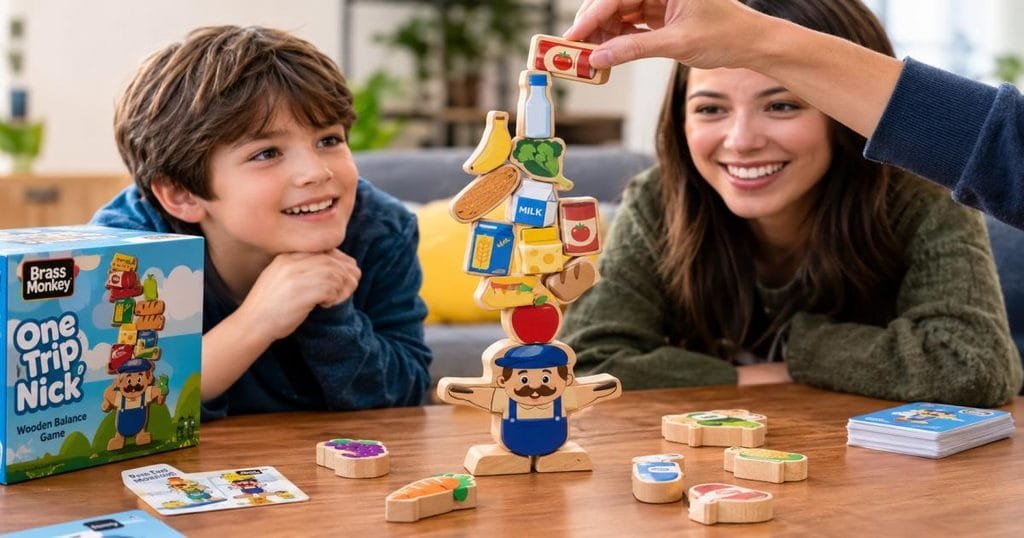
Players decide who starts. On your turn you pick any remaining piece and place it carefully on Nick or on the growing stack. Once you touch a piece you must try to play it. Once you release it you cannot adjust it again. You may rest pieces on any part of Nick, including the rocker around his feet, as long as the piece does not touch the table. Printed sides must stay visible; you cannot flip a piece face-down to create a flat platform.
Play moves left after each successful placement. If the stack stays up, the next player goes. If anything falls during your turn, you are out. The remaining players stand Nick up again and continue building. The last player still in the game wins. If every piece ends up stacked, the group can switch to a variation for a tiebreaker.
One Trip Nick Rules Explained
The core rules stay short so new players can start quickly.
Turn order is clockwise. Balancing rules require commitment: touch means you play the piece, release means it stays where it is. Pieces cannot touch the ground and cannot sit printed-side down. A fall on your turn removes you. The winner is the last remaining player. If the full stack succeeds, use a variation to decide the winner.
Beginners benefit from a few practical notes. Early pieces set the foundation. The rocker base means Nick is never perfectly still, so weight needs to stay centered. Awkward shapes such as the hockey stick or cactus need support underneath. Steady hands matter more than speed. Most groups learn the flow in one round and improve placement choices by the second or third game.
One Trip Nick Game Variations and House Rules
The basic rules work well, yet a few changes keep sessions fresh.
In the random-item challenge, after you place a piece you choose which item the next player must use. This forces creative solutions and adds mild pressure. A timer-based challenge lets each player race alone to stack as many pieces as possible in 60 seconds. High-score mode suits solo play: keep adding pieces until the stack falls and record the best number. Beginner-friendly versions can allow one gentle adjustment after placement or let younger players use both hands. Family and party versions include team play, where partners share turns, or a light story mode where players invent reasons Nick needs each item.
These options stretch the game without changing its core feel.
How Difficult Is the One Trip Nick Balance Game?
Early turns feel easy. A bag or crate rests comfortably on Nick’s arms or head. As more pieces join the pile, weight distribution becomes critical. The rocker base amplifies small imbalances. Oddly shaped items create leverage problems that demand careful placement.
New players usually grasp the basics in one or two rounds. The rules are few, so the learning curve stays short. Mastery takes more practice. You begin to notice which shapes lock together and which ones create weak points. Difficulty rises naturally because each successful addition raises the center of gravity and shrinks stable surface area. That progressive challenge is part of the appeal—what starts as a casual stack turns into a tense balancing act by the middle of the round.
One Trip Nick Players, Age, and Play Time
Most listings recommend the game for ages 5 and up. Younger children can join with adult help and simpler expectations. Two to four players is the practical range. More people can play, but the limited pieces shorten each round. A typical session lasts about five minutes, so groups often play several rounds in a short sitting.
The game suits families, mixed-age groups, and parties. Kids enjoy the silly theme and the crash. Adults like the hand-eye challenge and the shared reaction when the pile collapses. It works as a quick filler between longer games or as a stand-alone activity that needs almost no teaching time.
One Trip Nick Wooden Pieces and Build Quality
The wood feels solid in the hand. Pieces are thick enough that repeated falls do not damage edges or printing easily. Artwork is double-sided and printed in a clean vintage style that matches the Brass Monkey look. The compact box makes storage and travel simple. When the stack falls, the pieces create a clear clatter rather than a fragile mess. A soft surface or game mat quiets the noise if the table is hard.
Brass Monkey One Trip Nick Review
Gameplay is physical and immediate. You feel the tension in your hands as the pile grows higher. The fun comes from the relatable theme and the spectacular failures. Replay value sits in the different shapes and the house-rule options; each session builds a new structure. Component quality matches the price—thick wood, clear printing, no cheap feel. Difficulty scales with the number of pieces. Family appeal is strong, and the short rounds make it useful for parties.
Strengths include the clever theme, near-zero setup time, solid build, and broad age range. Limitations include limited strategic depth compared with heavier games and the chance of repetition if groups play many rounds without variations. The game delivers exactly what it promises: light, laugh-filled balancing.
Pros and Cons of One Trip Nick
Pros
- Rules anyone can learn in minutes
- Setup takes almost no time
- Funny and unusual grocery-carrying theme
- Real physical dexterity challenge
- Strong fit for families and parties
Cons
- Can feel repetitive after many rounds without house rules
- Needs steady hand control that some players find frustrating
- Falling pieces can be noisy on hard tables
- Less strategic depth than larger board games
Is One Trip Nick Good for Families and Kids?
Yes. The age range of 5 and up works with supervision. Parent-and-child play is natural because adults can model careful placement while kids choose the next silly item. Skills practiced include fine motor control, spatial judgment, and patience. Safety is straightforward—thick wood, no sharp edges, and no small parts that pose risks for the recommended age. Keep an eye on very young children so pieces stay on the table.
Is Brass Monkey One Trip Nick Worth Buying?
Buy it if you want a light, funny, physical game for casual nights, parties, or mixed-age groups. Skip it if your table prefers deep strategy, long campaigns, or quiet abstract puzzles. At the typical $24 price the wood quality and replay potential give solid value. It makes a strong gift for anyone who has ever refused a second trip from the car, or for hosts who need a short, portable activity that gets people laughing. If your shelf needs a quick, conversation-starting title, One Trip Nick fits.
One Trip Nick vs. Other Wooden Balance Games
Compared with classic block-stacking games, One Trip Nick adds a rocking base and irregular shapes that raise the physical challenge. Difficulty sits between simple stacking toys and more precise dexterity titles. Components feel premium for the category—thick wood and dual-sided art stand out. Family and party appeal stay high because of the humor and short rounds. Choose One Trip Nick if you want a themed, laugh-out-loud experience rather than pure abstract precision. Players who enjoy light physical comedy and quick sessions will prefer it over more serious balance challenges.
Tips for Getting a Higher Score in One Trip Nick
Begin with wider, more stable pieces to create a solid base. Think about weight distribution early—place heavier items lower when possible. Use Nick’s arms, head, and rocker as platforms. Build gradually rather than rushing tall structures. Keep the center of gravity low and centered. Practice different combinations so you learn which shapes lock together. After a few sessions most players notice patterns that let them push the stack higher before the crash.
Final Verdict: Is One Trip Nick a Good Balance Game?
One Trip Nick works as a light, charming wooden balance game. The physical challenge feels immediate, the theme lands every time, and the components hold up well. Best reasons to play are the shared laughs, the short sessions, and the simple skill test. Families, party hosts, and casual players will enjoy it most. Recommendation: add it if you want an affordable, well-made, funny title that gets the table talking and laughing within minutes.
Frequently Asked Questions About Brass Monkey One Trip Nick
What is the Brass Monkey One Trip Nick wooden balance game?
It is a wooden stacking game where players take turns placing grocery-themed pieces onto a rocking man-shaped figure named Nick without toppling the stack.
How many pieces are included in One Trip Nick?
The game includes 19 wooden pieces: Nick plus 18 double-sided grocery items, along with an instruction sheet.
How many people can play One Trip Nick?
It works best with 2 to 4 players. More can join, but pieces run out faster. Solo high-score play is also possible.
What age is One Trip Nick suitable for?
Most listings recommend ages 5 and up. Younger children can play with adult help.
How do you win One Trip Nick?
The last player who has not caused the stack to fall wins. If every piece is successfully stacked, use a variation as a tiebreaker.
Is One Trip Nick difficult to play?
Basic play is easy to learn. Difficulty increases as more pieces are added because of the rocking base and irregular shapes. Most people improve quickly with practice.
Can you play One Trip Nick solo?
Yes. Track how many pieces you can stack before a fall for a personal high score, or use a timer for extra challenge.
Is One Trip Nick a good family game?
Yes. Short rounds, a funny theme, and a broad age range make it a strong choice for family game nights.
Where can you buy One Trip Nick?
It is available from the Brass Monkey / Galison site, major online retailers, museum shops, and specialty gift and game stores. Typical retail price is around $24.
The Brass Monkey One Trip Nick wooden balance game delivers a lighthearted physical challenge wrapped in a theme almost everyone understands. Whether you play with family, friends, or alone for a quick high-score try, Nick and his impossible grocery load keep the table laughing.