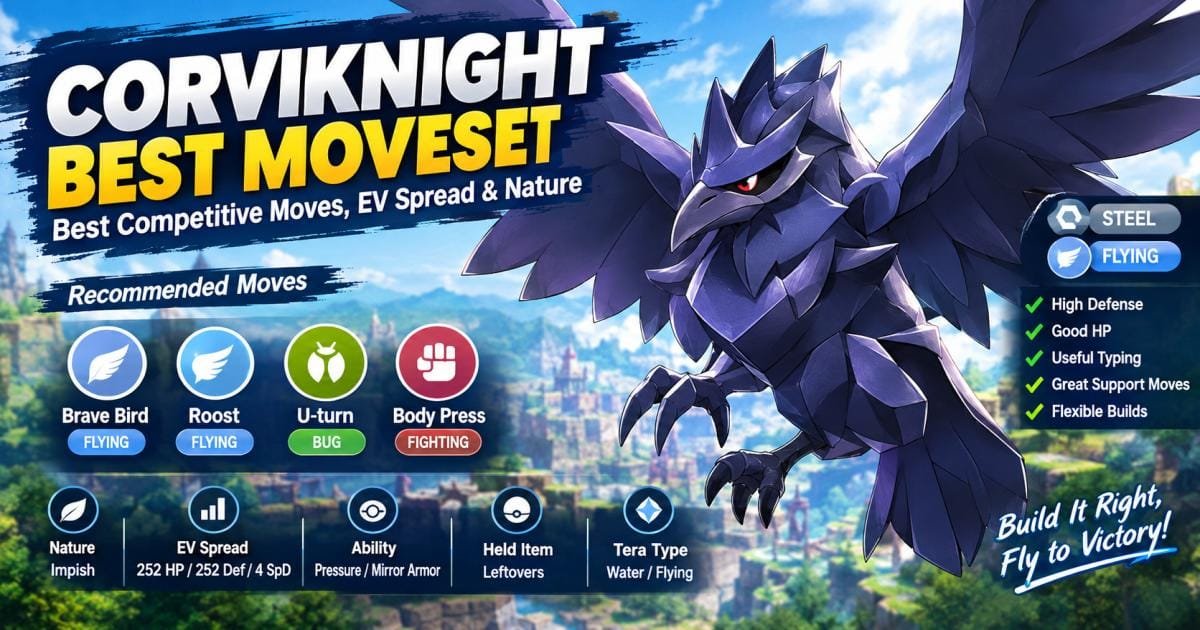

The best moveset for Corviknight in competitive play is Roost, Brave Bird, U-turn, and Body Press, paired with the Pressure ability, a Rocky Helmet or Leftovers, an Impish nature, and 248 HP / 252 Def / 8 SpD EVs. This build gives Corviknight a wall that tanks physical hits, punishes contact moves, clears entry hazards, and pivots teammates into better matchups.
Corviknight ranks around #13 in Gen 9 OU usage, and roughly 14% of teams run it. Few Pokémon combine this much bulk with this much team support. This guide covers the full Corviknight best moveset for competitive play: moves, EVs, nature, ability, item, and Tera Type,e plus the format-specific tweaks that separate a singles build from a doubles one.
Corviknight Best Moveset at a Glance
Here’s the build in one glance:
- Ability: Pressure (singles) or Mirror Armor (doubles)
- Item: Rocky Helmet or Leftovers
- Nature: Impish
- EVs: 248 HP / 252 Def / 8 SpD
- Moves: Roost, Brave Bird, U-turn, Body Press (swap Body Press for Defog when hazard removal matters more)
Why Corviknight Is Good in Competitive Battles
Steel and Flying typing carries most of the credit. Corviknight resists eight types Grass, Bug, Normal, Flying, Psychic, Dragon, Steel, and Fairy and is immune to Ground and Poison. Only Fire and Electric hit it for double damage, a short weakness list for this much bulk.
Roost adds reliable recovery on top of that typing. Defog and U-turn add team support most walls never get. That mix explains why Corviknight sits near the top 15 most-used Pokémon in Gen 9 OU, with usage hovering around 14%.
One detail trips up new players: pure Flying-types take double damage from Stealth Rock, but Corviknight’s Steel half cancels that out. It takes standard hazard damage, so it can switch in match after match without losing extra HP for no reason.
Corviknight Best Moveset for Competitive Battles
Four moves make up the core Corviknight set. Each one solves a different problem.
Brave Bird
Brave Bird gives Corviknight real offense. It’s a 120-power Flying move with same-type bonus, strong enough to punish an opponent who assumes Corviknight only stalls. Roughly half of competitive Corviknight in Gen 9 OU carry it. The catch is recoil: every hit costs Corviknight HP too, so time it instead of spamming it. Iron Head trades power for safety if recoil worries you.
Roost
Roost is close to mandatory. Nearly every competitive Corviknight carries it, and usage sits close to 100%. It heals half of Corviknight’s max HP each use. One catch: for that turn, Corviknight loses its Flying typing. That detail causes more losses than it should;d see the mistakes section below.
U-turn
U-turn trades a small hit of damage for tempo. Bring Corviknight in, take the hit meant for it, then pivot into a teammate who punishes whatever the opponent revealed. Close to 60% of competitive sets run it, which shows how much trainers value that free momentum.
Body Press
Body Press calculates damage from Defense instead of Attack. Since Corviknight already stacks Defense, this turns a wasted stat into real offense. It hits Steel, Rock, and Dark-types the Pokémon that normally wall Corviknight all day especially hard. Just under half of competitive Corviknight run it.
Best EV Spread for Corviknight
248 HP / 252 Def / 8 SpD with an Impish nature is the standard spread, and it’s the single most common EV spread in Gen 9 OU, appearing on about a quarter of all Corviknight. The 248 HP, instead of a round 252, is a small trick competitive players use to land on better numbers for surviving repeat hits and hazard damage. Most remaining points go into Defense, since tanking physical attacks is the job, with a handful left over for Special Defense.
Doubles changes the math. The most common doubles spread runs a Careful nature with 36 Atk / 236 Def / 232 SpD / 4 Spe, splitting bulk across both defenses since doubles formats throw out more special damage than singles do. Some players also try a speed-focused Bold spread: 60 HP / 252 Def / 196 Spe to outrun specific threats, trading raw bulk for speed.
Best Nature for Corviknight
Impish Nature
Impish (+Defense, -Special Attack) works because it boosts the stat Corviknight leans on and cuts a stat it rarely uses. Its Special Attack sits at a mediocre 53 base, so losing it costs nothing. This is the standard nature for the singles wall-and-pivot set.
Careful Nature
Careful (+Special Defense, -Special Attack) earns its spot when special pressure runs heavy, which is exactly why it’s the top nature in doubles. Fire Blasts, Electric attacks, and Dragon-type special moves show up constantly in that format.
Other Nature Options
Bold (+Defense, -Attack) and Calm (+Special Defense, -Attack) both make sense if Brave Bird isn’t in the set. Body Press ignores Attack completely, so dropping that stat costs nothing while still boosting a defense stat. Both fit the specially defensive builds covered later in this guide.
Best Ability for Corviknight
Corviknight can run three abilities, and the right one depends on format.
Pressure
Pressure doubles the PP cost of any move used against Corviknight. In a slower singles format, that adds up: an opponent’s best attacker can run dry on moves several turns earlier than planned. Almost 99% of competitive Corviknight in Gen 9 OU run Pressure, making it the clear standard for singles.
Mirror Armor
Mirror Armor reflects stat-lowering effects at whoever caused them, including Intimidate. Doubles and VGC are full of Intimidate users, Incineroar and Landorus among them, which is why Mirror Armor takes over as the top pick in that format. Punishing an Intimidate user by lowering their Attack instead is a real swing in a close game.
Unnerve
Unnerve blocks the opponent’s Pokémon from eating held Berries. Competitive play barely touches it, since Pressure and Mirror Armor both deliver more consistent value. It only earns a slot against specific Berry-reliant strategies.
Best Held Item for Corviknight
Rocky Helmet leads in singles, with around 69% of competitive Corviknight in Gen 9 OU carrying one. Since Corviknight gets hit constantly by design, Rocky Helmet turns every contact move against it into chip damage for the attacker.
Leftovers is the reliable alternative, stacking passive healing on top of Roost. It sits around 22% usage in singles and takes the top spot in doubles, where more than half of competitive sets carry it.
Heavy-Duty Boots let Corviknight ignore entry hazards without spending a moveslot on Defog. In VGC, Sitrus Berry is common too, showing up on close to 60% of Corviknight in recent VGC 2026 data, a free mid-battle heal that helps it survive a big hit and fire back.
Best Tera Type for Corviknight
Dragon leads by a wide margin, and the logic holds up: Dragon resists both Fire and Electric, Corviknight’s only two natural weaknesses. Tera into Dragon, and Corviknight has no bad matchups left on paper. It’s the top Tera Type in singles OU and shows up on roughly 70% of doubles sets.
Fighting is the offensive pick. Tera into Fighting and Body Press gains a same-type bonus, turning Corviknight into a real attacker instead of just a wall. It’s the second most common Tera Type in singles. Ice, Water, Steel, Fairy, and Ghost all see occasional use as answers to specific matchups.
Alternative Corviknight Competitive Movesets
The core four-move set isn’t the only strong option. These four builds solve different problems.
Iron Defense + Body Press Corviknight
Trainers call this the Ironpress set: Iron Defense, Body Press, Roost, and Iron Head or Bulk Up in the last slot. Stack Defense boosts, then use that same stat to fuel Body Press. This build turns Corviknight into a real threat against Steel, Rock, and Dark-type teams that would otherwise shut it down completely.
Defensive Pivot Corviknight
This set runs Roost, Defog, U-turn, and Brave Bird; it’s the most support-heavy version, built to clear hazards while keeping momentum on your side. Defog appears on more than 70% of competitive Corviknight, so teams that lean on hazard control usually land here.
Specially Defensive Corviknight
Shift the EVs and nature toward Special Defense Calm or Careful, split between HP and S, and Corviknight checks special attackers as well as physical ones. This build shows up often in doubles, where special damage comes from more directions.
Bulk Up Corviknight
Bulk Up, Roost, Body Press, and Brave Bird or Iron Head make up a slower setup sweeper. Bulk Up raises Attack and Defense together, and since Body Press scales with Defense, every boost does double duty. VGC teams use this set regularly, often alongside Tailwind support.
How to Use Corviknight in Competitive Battles
Play Corviknight proactively, not passively. Bring it in when you can predict a physical attack or a status move, take the hit, then Roost to reset before it wears down. Save Defog for a safe turn, ideally right after forcing a switch instead of using it on reflex. Use U-turn to keep the game moving once Corviknight has done its job in that exchange. Before committing Corviknight to a matchup, check the opposing team for strong Fire or Electric attackers, since those are the two threats that can actually break through it.
Corviknight’s Best Teammates
In singles, Corviknight fits naturally into a defensive core. Its most common teammates are Dondozo, Slowking-Galar, Gliscor, Toxapex, Clodsire, and Blissey, bulky Pokémon that cover its Fire and Electric weaknesses while Corviknight handles Ground and Fighting attacks aimed at them.
Doubles shifts the supporting cast. Gouging Fire, Sinistcha, Ogerpon-Wellspring, and Grimmsnarl show up often, and VGC teams frequently add Garchomp, Tyranitar, and Excadrill, giving Corviknight’s Tailwind and Mirror Armor room to set up the rest of the team’s offense.
Corviknight Counters and Weaknesses
Corviknight’s only weaknesses are Fire and Electric, both at double damage. That’s a short list, but a real one. Strong special Fire and Electric attackers can punch through even a heavily invested defensive spread, since Corviknight’s natural Special Defense sits lower than its Defense. Taunt users cause real trouble too, since they lock out Roost and Defog and turn Corviknight into dead weight. Setup sweepers that outlast its damage output, and Pokémon carrying coverage moves it doesn’t resist, round out the list.
Corviknight in Singles vs. Doubles
Corviknight in Singles
Singles treats Corviknight as a defensive backbone piece. It runs Pressure, leans on Defog and U-turn for support, and uses Roost to survive a long game. Its steady top-15 usage in Gen 9 O and U, roughly 14% of teams, reflects how reliable that role has become.
Corviknight in Doubles
Doubles shifts Corviknight toward support and setup. Mirror Armor punishes Intimidate, Tailwind hands the team a speed advantage, and Bulk Up turns it into a slow but real offensive threat once boosted. Same Pokémon, different job, depending on the format.
Common Mistakes When Using Corviknight
- Adding Attack or Special Attack EVs on a Body Press set. Body Press uses Defense for its damage math, so those points do nothing.
- Using Roost on a turn the opponent can hit with a Ground move. Roost strips Flying typing for that turn, and the Ground immunity disappears right when it matters most.
- Spamming Brave Bird without tracking recoil. In a long defensive game, that recoil typically costs a KO nobody saw coming.
- Skipping Special Defense investment entirely. A one-dimensional physical wall typically gets picked apart by any team with real special firepower.
- Dropping hazard control on a team that needs it. If nothing else removes hazards, cutting Defog for pure offense can quietly cost the game.
Final Corviknight
Start with Roost, Brave Bird, U-turn, and Body Press, Pressure ability, Rocky Helmet, Impish nature, and 248 HP / 252 Def / 8 SpD EVs. It’s the most tested version of Corviknight, and it fits almost any singles team that needs a defensive backbone. From there, adjust: swap in Defog for hazard control, try Mirror Armor and Bulk Up for doubles, or run the Ironpress set when the team needs another answer to bulky Steel-types. Corviknight rewards that kind of tuning more than most walls do.
FAQs
What is the best moveset for Corviknight?
Roost, Brave Bird, U-turn, and Body Press cover recovery, damage, pivoting, and coverage in one set. Swap Body Press for Defog when hazard removal matters more.
What is the best Nature for Corviknight?
Impish works best for singles. Careful works better in doubles, where special damage comes from more directions.
What is the best EV spread for Corviknight?
248 HP / 252 Def / 8 SpD is the standard singles spread. Doubles players typically run 36 Atk / 236 Def / 232 SpD / 4 Spe instead.
Is Impish or Careful better for Corviknight?
Impish suits singles OU, where physical attackers dominate. Careful suits doubles and VGC, where special attacks come from more angles.
Is Pressure or Mirror Armor better for Corviknight?
Pressure wins in singles, where draining PP over a long game matters. Mirror Armor wins in doubles, where Intimidate and other stat drops show up constantly.
Is Body Press good on Corviknight?
Yes. It scales with Defense instead of Attack, turning Corviknight’s best stat into real offense, especially alongside Iron Defense.
Is Iron Defense good on Corviknight?
Yes. Boosting Defense makes Corviknight harder to break and hits harder at the same time through Body Press.