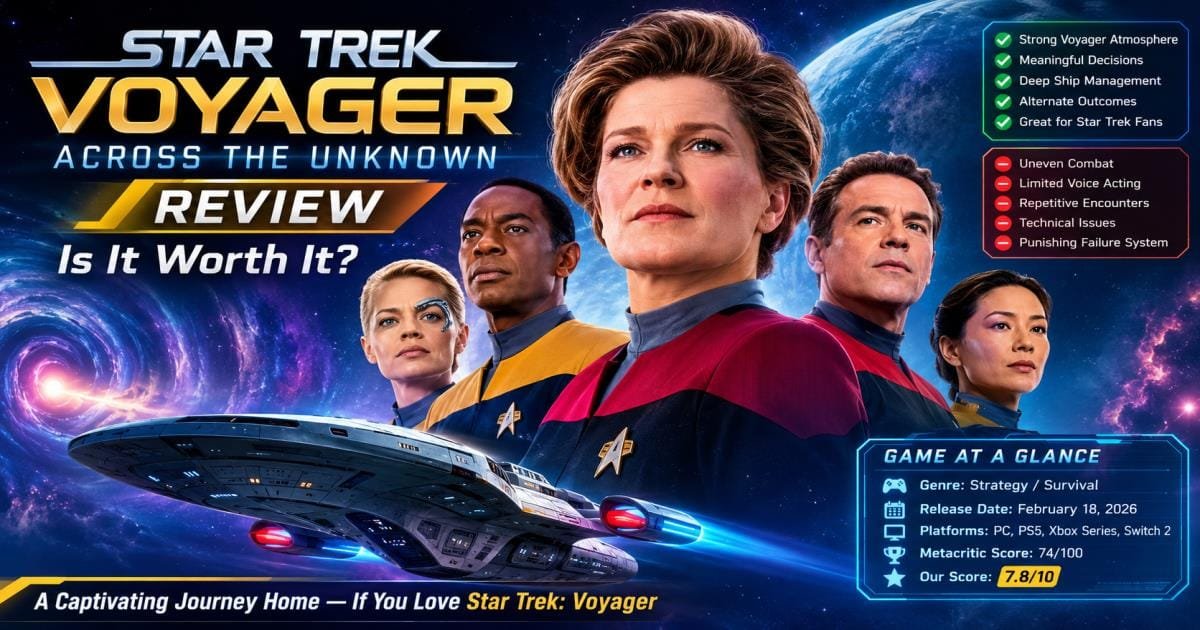

Yes. If you love Star Trek: Voyager and enjoy managing a starship while making hard choices that actually change the story, Star Trek Voyager Across the Unknown is worth playing. The game puts you in Captain Janeway’s chair and lets you reshape the Delta Quadrant journey in ways the TV show never did. Fans who want real agency over Voyager’s fate will find a lot to enjoy. Players looking for fast action or polished cutscenes may walk away less impressed.
This star trek voyager across the unknown review covers the full experience so you can decide for yourself.
Star Trek Voyager Across the Unknown Review at a Glance
Quick verdict
A thoughtful survival strategy game that captures the isolation and moral weight of Voyager better than most licensed titles. Strong ship rebuilding and meaningful decisions stand out. Combat and presentation fall short of the same standard.
Overall strengths and weaknesses
The best parts are the authentic Delta Quadrant atmosphere, choices that create different outcomes, and the deep ship management loop. Weaker areas include combat that can feel repetitive, limited voice work, and resource pressure that sometimes frustrates.
Who should play it
Fans of the original series, players who like management games with lasting consequences, and anyone who wants to experiment with “what if” versions of Voyager’s story.
Who may want to skip it
People who prefer pure action games, those who dislike reading a lot of text, or players who get stressed by permanent setbacks and tight resources.
Review score and platforms
Critics typically score it in the mid-to-high 70s. User scores run higher among fans of the show. It launched on February 18, 2026, for PC, PlayStation 5, Xbox Series X/S, and Nintendo Switch 2. The base price sits near $40.
What Is Star Trek Voyager Across the Unknown?
Gamexcite built the game and Daedalic Entertainment published it. You take control of the USS Voyager right after the events of the pilot episode “Caretaker.” The ship is badly damaged, resources run low, and the crew is stranded 70,000 light-years from home in the Delta Quadrant.
The game mixes survival strategy with story choices. You repair and rebuild Voyager room by room, manage fuel, food, and materials, assign crew, explore systems, and face decisions that alter the path home. The journey splits into 12 sectors. Many star systems and events generate differently each playthrough, so the map never feels identical twice.
The story follows the broad shape of the TV series but constantly opens doors the show never took. You can stay close to the original path or push the crew into very different territory. That freedom is the main reason many players keep coming back.
Star Trek Voyager Across the Unknown Gameplay Review
Ship management forms the core of daily life. Voyager arrives in pieces. You clear wreckage, restore rooms, and decide what to build next. Need better food production? Build hydroponics. Want stronger defenses? Focus on shield generators and weapons. Every room draws power, and power is limited, so you make real trade-offs.
Resource management keeps the pressure on. Deuterium (fuel) is the most critical supply. Run out and the ship stops. You gather materials from planets, derelict ships, and stations while balancing exploration against the risk of getting stranded. Food and repair supplies matter just as much.
Crew management adds another layer. Key officers provide bonuses when placed in the right rooms. Away teams succeed or fail based on who you send. Morale drops when conditions get harsh or losses mount. Characters gain experience and unlock useful abilities over time.
Exploration works at the system level. You warp between points of interest, scan for resources, send teams on missions, and decide whether to help strangers or move on. Research unlocks new technologies that can change how the ship works, including options the original crew might have rejected.
Every major decision carries weight. Alliances, crew survival, and technology choices shape which endings become available. The game supports several distinct outcomes, so one playthrough never tells the full story.
How Does the Story Compare With Star Trek: Voyager?
The game hits many familiar moments from the series while letting you rewrite them. You meet the Caretaker, face the Kazon, deal with the Borg, and encounter other key events, but your choices decide who joins the crew, who survives, and how those events resolve.
The main characters feel true to the show. Dynamics between Janeway, Chakotay, Tuvok, B’Elanna, Tom Paris, Harry Kim, and the Doctor play out with care. Tim Russ and Robert Duncan McNeill return to voice sector logs as Tuvok and Tom Paris. Hearing the original actors adds a layer of authenticity that text alone cannot match.
New paths let you explore ideas the series only hinted at. You can lean harder into Borg technology, recruit different people, or take moral shortcuts the show avoided. The tone of isolation, curiosity, and hard ethical choices stays consistent. Fans will recognize deep cuts and smile at the references. The branching structure makes the journey feel personal rather than a simple retelling.
Combat and Strategy: What Works and What Doesn’t
Combat puts you in the captain’s role. You do not fly the ship or aim the weapons yourself. Instead you issue orders: target specific enemy systems, defend, reposition for better angles, or trigger crew abilities. Positioning matters because shields and systems sit on different sides of a ship. Energy must be shared between weapons, shields, and other systems, forcing constant choices.
The best fights reward planning and timing. Failure can cost crew members, damage rooms, or waste scarce resources. The system ties into ship building, so a combat-focused Voyager plays differently from one built for exploration or science.
Some encounters grow repetitive. The combat never reaches the same depth as the management systems. Random elements can occasionally feel unfair. It supports the story well enough but is not the strongest part of the game.
Graphics, Animation, Sound, and Presentation
The ship interior view is clean and easy to read. Exterior designs respect the look of the USS Voyager. Character models and animations get the job done but rarely impress. Some movements look stiff.
Voice work is limited outside the sector logs from Tim Russ and Robert Duncan McNeill. Most dialogue appears as text. The original series theme appears in the full game and helps set the mood. Music and sound effects support the atmosphere without standing out.
Compared with bigger-budget Star Trek titles, the presentation feels modest. It serves the management and story systems without getting in the way, but players who want cinematic polish may notice the difference.
Difficulty, Replayability, and Game Length
New players face a learning curve. Early resource mistakes can cascade, and consequences stick. Later updates added manual saves and softened the easiest difficulty setting, which helps a great deal.
A typical run lasts 15 to 25 hours depending on how much you explore. Multiple endings and different ship builds encourage extra playthroughs. Procedural systems and alternate story paths keep later runs feeling fresh. Many players return simply to try a more aggressive path, a peaceful path, or a run that prioritizes different crew members.
Star Trek Voyager Across the Unknown Pros and Cons
Pros
- Strong sense of being stranded in the Delta Quadrant
- Decisions that create different outcomes
- Deep ship rebuilding and resource systems
- Multiple endings and high replay value
- Clear appeal for fans who want control over Voyager’s story
Cons
- Combat that can feel repetitive
- Limited voice acting outside key logs
- Some encounters that repeat too often
- Occasional technical rough edges
- Resource pressure that can frustrate
Is Star Trek Voyager Across the Unknown Worth It?
For Star Trek: Voyager fans
Yes. The chance to live the journey and change it is rare. The atmosphere and character moments land for people who know the show.
For strategy and management players
Yes, if you enjoy ship building, tight resources, and choices that stick. The management loop is the strongest part of the experience.
For casual gamers
It depends. The length and resource pressure may feel heavy. Start on the easiest difficulty and take your time.
For players unfamiliar with Voyager
It still works as a solid sci-fi management game, but many emotional beats hit harder if you know the series.
Value for the price
At around $40, it offers solid value for players who will finish one run and likely start another. Others may prefer waiting for a discount.
Star Trek Voyager Across the Unknown vs Other Star Trek Games
Most recent Star Trek games focus on action, large-scale strategy, or pure story adventures. This one stands out by centering on one ship, daily management, and personal decisions. It shares some DNA with classic command-focused titles and modern survival strategy games. Players who want big battles or cinematic set pieces should look elsewhere. Those who want to feel like a starship captain making hard calls will find this approach more satisfying.
Final Verdict:
Star Trek Voyager Across the Unknown is a flawed but sincere success. It earns a clear recommendation for its target audience.
The strongest reason to play is the rare chance to command Voyager and shape its story while managing the ship that becomes your home.
The biggest reason to hesitate is the gap between the excellent management and story systems and the more limited combat and presentation.
Buy it if the idea of rewriting Voyager’s journey appeals to you. Play on a comfortable difficulty, take your time with the ship systems, and enjoy the freedom to choose your own path through the Delta Quadrant. For the right player, this is one of the most rewarding Star Trek games in years.
Frequently Asked Questions
Is Star Trek Voyager Across the Unknown worth playing?
Yes for fans of the series and management games. The story choices and ship systems deliver a strong experience.
Is Star Trek Voyager Across the Unknown good for new players?
It has a learning curve, but easier difficulty options and quality-of-life updates make it more approachable. Knowing the show helps but is not required.
How long does Across the Unknown take to complete?
Most players finish a main story run in 15 to 25 hours. Side content and different endings add more time.
Is Across the Unknown difficult?
It can be, especially with resource pressure and lasting consequences. Difficulty settings and manual saves reduce the stress.
What platforms is Star Trek Voyager Across the Unknown available on?
PC, PlayStation 5, Xbox Series X/S, and Nintendo Switch 2.
Does the game have multiple endings?
Yes. Several distinct endings depend on major choices, crew survival, and key decisions late in the journey.
Can your choices change Voyager’s story?
Yes. That is one of the central features. You can stay close to the series or take the crew in very different directions.